

Introduction
Res judicata means a thing already decided. It prohibits a court from adjudicating a matter that a competent court has already decided. Indian legal framework comprises it under Section 11 of the Code of Civil Procedure, 1908.
Res Judicata Meaning
It prevents the Court from adjudicating again the decided matter in issue. The doctrine is based on three theories. The first is Interest reipublicae ut sit finis litium, which means it is in the interest of the State that litigation ends. Second is Nemo debet bis vexari pro una et eadem causa, which means no man should be vexed twice for the same cause. Lastly, the third one, Res judicata pro veritate occipitur, meaning a judicial decision must be accepted as correct.
Thus, doctrine is founded on justice, equity and good conscience for society as well for individuals.
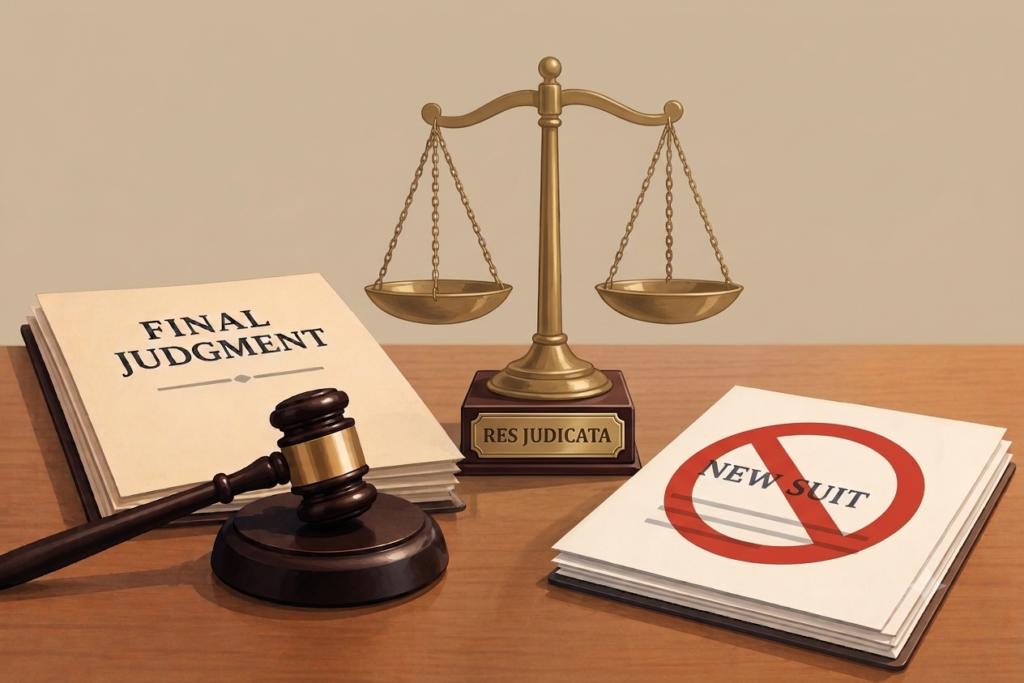
Image generated by Gemini
Essentials of Res Judicata Under Section 11 CPC:
Section 11 of the Act enumerates the essentials for applying res judicata in a later suit. Those essentials are as follows:
1. Matter Directly and Substantially in Issue: Res judicata applies when the “matter in issue” was directly and substantially in issue in the former suit. The matter in issue determines res judicata. It becomes directly and substantially in issue when alleged and denied or admitted by the parties. Further, it includes any matter that could be a ground of defence or attack in the former suit.
2. Between Same Parties: Next, the parties in the former and latter suits are considered. The parties should be the same in both suits. The privies of the former suit parties are also barred by res judicata. Therefore, the former suit decision is binding on the legal representatives, such as a son or daughter or successor of a trustee, of the parties in that suit. Likewise, in bona fide PIL, as per Explanation VI of the section, all the interest-holding individuals are barred by the doctrine.
3. Litigating under Same Title: Parties must be under the same title or capacity for the application of Res judicata. For example, in the first case, a person contesting property recovery as heir of the deceased is not barred from litigation in the latter suit as manager of the math.
4. Competency of the Court: The former suit must have been adjudicated by the competent Court for the application of the doctrine. The right of appeal from the Court’s decision does not determine its competency.
5. Heard and Finally Decided: The matter in issue in the former suit has been heard and finally decided by the court in the previous suit is the last condition of res judicata. It is immaterial that the former suit was disposed of ex parte or dismissed on failure to produce evidence. Necessary is that the former suit was decided on merits.
Constructive Res Judicata:
Order 2, Rule 2 of the Code states that the Plaint must contain all claims with respect to the cause of action. Any omission of a claim is not allowed to be filed in a later suit. This constitutes constructive res judicata. It implies that any ground of defence in the former suit, necessary for a complete and final decision, ought to have been pleaded as a defence. One can’t keep it for another suit. In “State of U.P. v. Nawab Hussain (AIR 1977 SC 1680)”, the Court held that res judicata also covers those issues or facts that are clearly part of the subject matter of the litigation and could have been raised. Further, the Court, in “C. A. Balakrishnan v. Commr., Corporation of Madras (AIR 2003 MAD 120)”, held that a claim cannot be raised by way of writ if it is barred in a later suit.
Res judicata and Criminal proceedings:
The Court, in Pritam Singh and Anr. v. The State of Punjab (AIR 1956 SC 415), held that ‘res judicata pro veritate accipitur’, meaning res judicata is no less applicable to criminal than to civil proceedings. Article 20 of the Indian Constitution protects a person from prosecution and punishment more than once for the same offence. Further, Section 337 of the BNSS, 2023 provides that a person once convicted or acquitted shall not be tried for the same offence. In S.C. Garg v. State of U.P. (2025 SCC OnLine SC 791), the Supreme Court reaffirmed the Pritam Singh judgment in criminal proceedings.
Conclusion:
The doctrine is based on justice, equity and good conscience. It is so because it safeguards the system from endless litigation and saves individuals from multiple litigation. Res judicata protects public as well as private interests by providing conclusiveness to the litigation. It applies irrespective of whether the nature of proceedings is civil or criminal.
Written by:
Sonali Ray.

Divya
Now I understood why a case cannot be tried again once it has been finally decided by the court.
Gaurav
now, i understand why a court’s final decision needs to be respected.