

India has long struggled with the uneven distribution of water resources. While some regions experience devastating floods, others continue to face recurring droughts. The Bundelkhand region, spread across Madhya Pradesh and Uttar Pradesh, has witnessed years of water scarcity, crop failures, and migration due to inadequate irrigation facilities. To address these challenges, the Government of India launched the Ken–Betwa Project, the country’s first inter-basin river-linking initiative under the National Perspective Plan. The project promises irrigation, drinking water supply, and hydropower generation. However, it also raises an important legal question: Can India pursue development without compromising environmental protection and the rights of vulnerable communities?
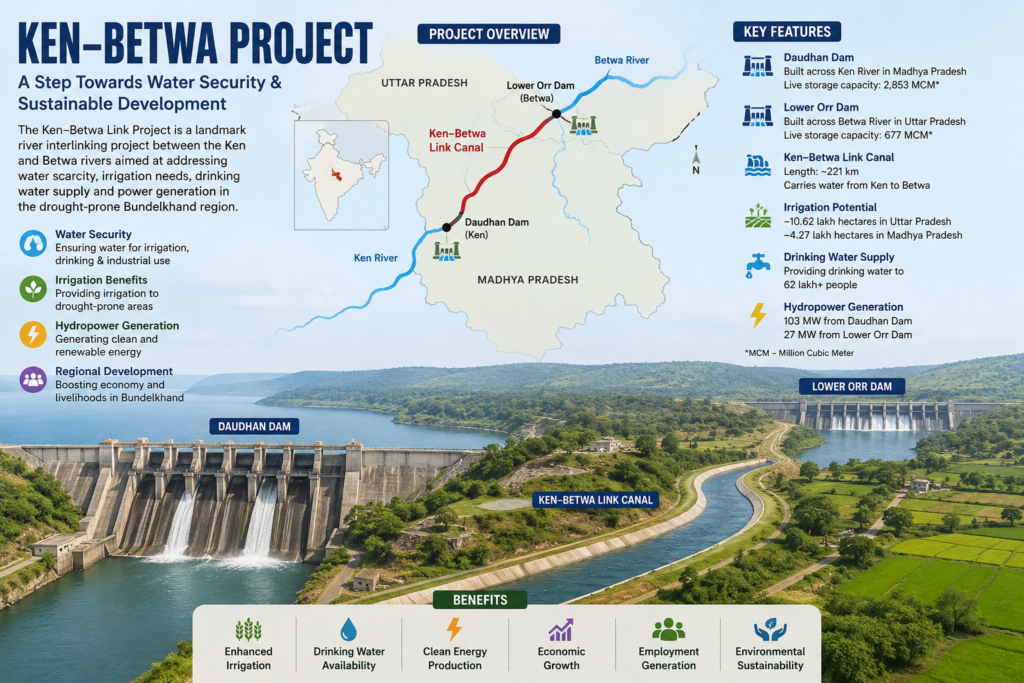
The Ken–Betwa River Linking Project proposes to transfer surplus water from the Ken River to the water-deficient Betwa River through the construction of the Daudhan Dam and a network of canals. According to the Government, the project is expected to irrigate over ten lakh hectares of land, provide drinking water to millions of people, generate hydroelectric power, and promote economic development in the drought-prone Bundelkhand region. While these objectives are significant, the project has also triggered debates on environmental sustainability, forest conservation, and the displacement of local communities.
From a constitutional perspective, the project must be evaluated in light of Article 21 of the Constitution, which guarantees the right to life. The Supreme Court has consistently interpreted this provision to include the right to a clean and healthy environment. At the same time, access to water is equally essential for a dignified life. Therefore, the State must balance developmental needs with environmental protection. Articles 48A and 51A(g) further reinforce this responsibility by directing the State and citizens to protect forests, wildlife, and the natural environment. These provisions reflect the constitutional commitment to sustainable development, which seeks to harmonize economic progress with ecological preservation. Similarly, the Public Trust Doctrine and the principle of inter-generational equity require the government to manage natural resources responsibly so that future generations are not deprived of them.
The project is also governed by several important environmental and land laws. The Environment (Protection) Act, 1986 and the Environmental Impact Assessment (EIA) Notification, 2006 require environmental assessment and regulatory approval before such projects can proceed. Since parts of the project affect forest land and the Panna Tiger Reserve, the Forest (Conservation) Act, 1980 and the Wildlife (Protection) Act, 1972 become particularly relevant. Furthermore, the Forest Rights Act, 2006 seeks to protect the rights of forest-dwelling tribal communities, while the Right to Fair Compensation and Transparency in Land Acquisition, Rehabilitation and Resettlement Act, 2013 ensures compensation and rehabilitation for affected families. Where Scheduled Areas are involved, the Panchayats (Extension to Scheduled Areas) Act, 1996 (PESA) also emphasizes the role of local Gram Sabhas in decisions affecting tribal communities.
Ken Betwa Project Related Judgments
Judicial precedents provide valuable guidance for evaluating projects of this nature. In In Re: Networking of Rivers (2012), the Supreme Court encouraged the implementation of river-linking projects while emphasizing that they must comply with existing legal requirements. In Narmada Bachao Andolan v. Union of India (2000), the Court upheld a major dam project but stressed that environmental safeguards and proper rehabilitation of displaced people were essential. Similarly, Vellore Citizens’ Welfare Forum v. Union of India (1996) established the principles of sustainable development and the precautionary principle as integral components of Indian environmental law. In Samatha v. State of Andhra Pradesh (1997), the Court recognized the importance of protecting tribal rights over land and natural resources, a principle that remains relevant whenever development projects affect indigenous communities.
India’s earlier infrastructure projects also offer valuable lessons. The Indira Gandhi Canal Project transformed large parts of Rajasthan by improving irrigation and agricultural productivity, demonstrating how water transfer can support regional development. In contrast, the Sardar Sarovar Project highlighted the social costs of large dams, particularly the displacement of tribal communities and prolonged legal disputes over rehabilitation. These experiences underline that engineering success alone cannot define the success of a public project; effective rehabilitation and environmental protection are equally important.
Impact of Ken Betwa River Project
Perhaps the most sensitive issue surrounding the Ken–Betwa Project is its impact on tribal communities and biodiversity. The diversion of forest land may affect the habitat of wildlife in the Panna Tiger Reserve while also disrupting the livelihoods of forest-dependent families. For many tribal communities, forests are not merely a source of income but also a part of their cultural and social identity. Therefore, compensation should extend beyond financial assistance to include meaningful rehabilitation, livelihood restoration, and respect for rights recognized under the Forest Rights Act.
Conclusion
The Ken–Betwa River Linking Project represents both an opportunity and a challenge. If implemented responsibly, it has the potential to improve water security, agriculture, and regional development in Bundelkhand. However, its long-term success will depend on strict compliance with constitutional principles, environmental laws, and the protection of affected communities. True development is not measured only by dams, canals, or economic growth; it is measured by the ability to achieve progress while preserving nature, respecting human dignity, and ensuring justice for present and future generations.
Written by – Monu Kumar
