

Introduction:
The Constitution of India consists of a Preamble, 448 Articles under 25 Parts, and 12 Schedules, presently. Being the supreme law of the land, people have brought many cases before the Indian Judiciary regarding its enforcement. However, the Court does not enforce the Preamble in the same manner as Articles and Schedules. That’s why, a few years after its enactment, the question echoed in various judgments, is the Preamble part of the Indian Constitution? The judiciary answered affirmatively. But do you know how the judiciary decided this? If not, let’s discover.
What is Preamble?
The Preamble refers to the introduction to a Constitution which describes the essential principles and philosophy of that document. Our Preamble is based on the Objective Resolution introduced by Jawaharlal Nehru before the Constituent Assembly on 13 December 1946. That Resolution became the fundamental guiding principles and objectives while framing the Constitution. That’s why the Constituent Assembly decided to modify that resolution to make the Preamble of the Constitution. After the enactment of the Preamble with the Constitution, it provides the source of authority of the Constitution, the nature of the Indian State, the objectives of the Constitution, and the date of adoption of the Constitution.
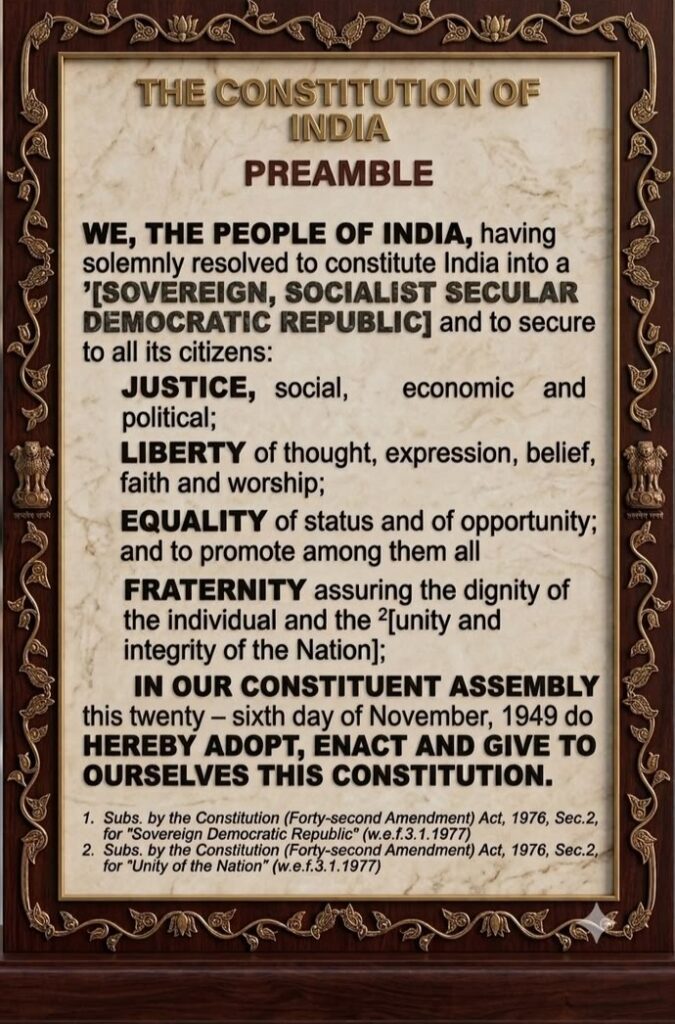
Pinterest Image by Rakeshkumarmbi
When the Preamble is not a Part of the Constitution:
Preamble was adopted alongwith the Constitution. However, till 1967, the Preamble was not considered part of the Constitution. In re: Berubari Union Case (AIR 1960 SC 845), the Supreme Court examined the Preamble influence on Parliamentary power. It observed that the Preamble could describe the Constitution-makers’ intentions but was not a source of the Government’s substantive powers. Thus, it held that the Preamble was not part of the Constitution and did not impose restrictions on the Parliamentary power.
Image generated by ChatGPT
Shift in Judicial Position:
The shift in judicial position took place during 1965-1967. In Sajjan Singh v. State of Rajasthan (AIR 1965 SC 845), the Petitioners challenged the 17th Amendment, abolishing the fundamental right to property. The majority bench upheld the constitutional validity of the amendment. However, Justice J.R. Mudholkar had a separate opinion and raised a separate question concerning the constitutional status of the Preamble.
Preamble becomes Part of Basic Structure of the Constitution:
The 13-judge constitutional bench in Kesavananda Bharati v. State of Kerala (AIR 1973 SC 1461) recognised the Preamble as part of the basic structure of the Constitution when considering the scope of constitutional amendment. This overruled the Berubari Union (1960) and acknowledged the Preamble as part of the Constitution. It stated that it expresses the fundamental Constitutional objectives and philosophy.
Consequently, the Court upheld the Preamble as amendable. This amendment is subject to the limit that it does not destroy the constitutional basic structure.
Is the Preamble Legally Enforceable?
The Preamble clarifies the language of constitutional provisions. However, when an article is plain and unambiguous, no reference to the Preamble is needed. Further, the Preamble can never enlarge the powers confided to the Government and confer any power per se by implication. It can never be the legitimate source of any implied power if withdrawn from the Constitution. Its true function is to explain the nature, extent, and application of the powers conferred by the Constitution. Thus, it cannot be enforced independently like Articles and Schedules.
Conclusion:
The Court now relies on the Preamble to interpret constitutional provisions while adjudicating their enforcement. In LIC of India v. Consumer Education and Research Centre (AIR 1995 SC 1811), the Court considered it for adjudicating the constitutional validity of the Insurance policy. Thus, the Preamble, is part of the Indian Constitution, does not have an independent source of power; however, it provides essential understanding of the Constitution makers’ intention behind the constitutional provision. This jurisprudence has developed through a series of judgments from Berubari to Kesavananda Bharati.
Written by:
Sonali Ray
