

Introduction
Imagine finding out that ₹20,000 has been wrongly debited from your bank account. You complain, wait, follow up, and then receive the same standard reply from the bank again. Going to court over the amount may not feel practical, so many people simply let the matter go. But there is another option: filing an Ombudsman complaint with the RBI.
The process is free and you do not need a lawyer to file it. Since 1 July 2026, the process is governed by the Reserve Bank–Integrated Ombudsman Scheme, 2026 (RB-IOS 2026), which replaced the 2021 scheme. This change matters because some of the rules are different, including the time limit for filing a complaint.
When Can You Make an Ombudsman Complaint?
The main ground for an Ombudsman complaint is “deficiency in service”. In simple terms, this means there has been some shortcoming in a service that the bank or other covered entity was supposed to provide, whether or not it has caused a financial loss. This is covered under Clause 3(1)(i).
The scheme covers several types of regulated entities, including commercial banks, regional rural banks, co-operative banks, certain non-bank prepaid instrument issuers, credit information companies and specified NBFCs. For some entities, the scheme applies only if they meet the prescribed conditions, such as having a customer interface or assets of ₹100 crore or more. Non-scheduled urban co-operative banks are covered where their deposits are ₹50 crore or above. Housing finance companies are excluded under the scheme.
So, before filing anything, it is worth checking whether the bank or entity involved is actually covered. Otherwise, the complaint may not be maintainable in the first place.
Complain to the Bank First, Then Watch the 90 Days
The first step is not the RBI. Complain to your bank first. Put the complaint in writing and keep the complaint number, email and any response you receive.
You generally have to wait 30 days, or the longer period prescribed under the applicable RBI, NPCI or card-network rules, before approaching the Ombudsman under Clause 10(1)(e)–(f).
There is another deadline that is easy to miss. Once the waiting period ends, you generally have 90 days to file the Ombudsman complaint, or 90 days from the bank’s last reply, whichever is later, as provided under Clause 10(1)(g). This is different from the older rules, so relying on an old blog that mentions a one-year period could lead to a missed deadline.
Also remember that the complaint must actually be addressed to the Ombudsman. Simply copying the RBI on a complaint sent to the bank does not count under Clause 10(1)(a). The same dispute should also not already be pending before a court or tribunal, subject to the applicable exceptions.
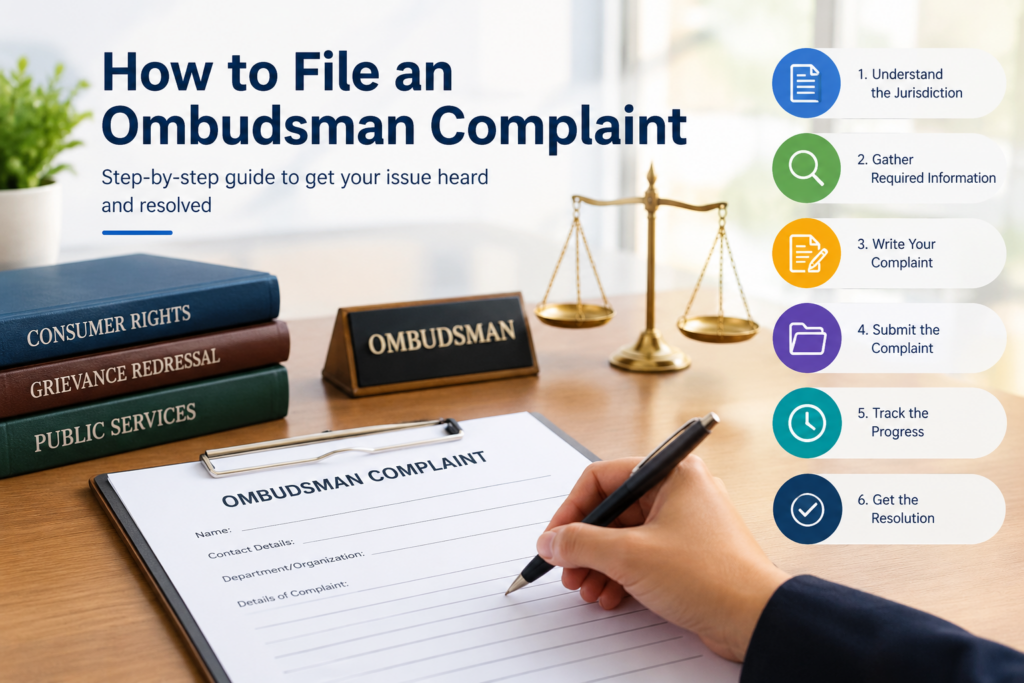
How to File Your Ombudsman Complaint
The process is fairly straightforward. Under Clause 11, you can file your Ombudsman complaint in three ways:
- through the RBI Complaint Management System at cms.rbi.org.in;
- by email at crpc@rbi.org.in; or
- by sending a signed complaint to the Centralised Receipt and Processing Centre, RBI, Central Vista, Sector 17, Chandigarh.
The RBI’s helpline, 14448, can help explain the process and provide guidance, but it is not itself the method for filing the complaint.
When filing, attach your original complaint to the bank, the bank’s response if you received one, and any documents that support your case. Most importantly, be clear about what you actually want. Instead of writing “take necessary action”, state the relief specifically. For example, you could ask for the reversal of ₹20,000 wrongly debited from your account on a particular date and compensation for the delay, where applicable.
There is no limit on the amount involved in a complaint, while the Ombudsman can award up to ₹30 lakh for consequential loss and up to ₹3 lakh for time, expenses and harassment under Clause 8(3).
What Happens After an Ombudsman Complaint Is Registered?
Once the complaint is registered, the bank gets 15 days to respond. If it does not respond, the Ombudsman may proceed ex parte, meaning the matter can be considered without waiting indefinitely for the bank’s response, as provided under Clause 14(2)–(3).
The process is meant to be relatively simple and summary in nature. The first attempt is generally to resolve the dispute through settlement, which may include conciliation. If that does not work, the matter can move towards an Award.
If an Award is passed in your favour, there is an important deadline to remember. Under Clause 15(4), the Award will lapse unless you accept it in full and final settlement within 30 days.
If you are not satisfied with the decision, the scheme also provides a right of appeal to the Appellate Authority within 30 days under Clause 17(3).
Conclusion
For an ordinary banking problem, an Ombudsman complaint can be a practical alternative to immediately approaching a court. But the process only works if you follow the deadlines and the basic procedure. Complain to the bank first, keep a record of everything, watch the 30-day and 90-day periods, and be specific about the relief you want.
For a very large or complicated dispute, especially one involving issues that require detailed evidence or witnesses, another legal remedy may be more appropriate. But where the problem is a straightforward banking service failure, the RBI Ombudsman route is worth knowing about—and using when the situation calls for it.
Source: Reserve Bank–Integrated Ombudsman Scheme, 2026.
