

Introduction:
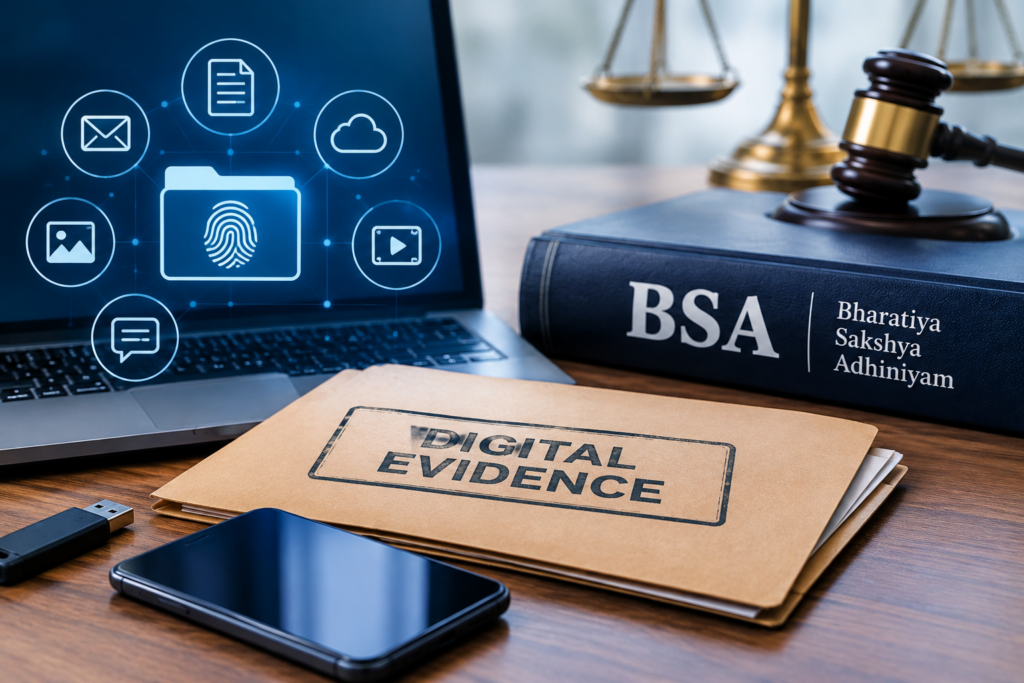
The thriving Digital growth has magnificently changed the medium of communications, conducting business operations and education. This makes it necessary to include and address digital information comprehensively in respect of evidence in law. Accordingly, the Bharatiya Sakshaya Adhiniyam, 2023, (BSA), has plausibly attempted to modernise the Indian’s evidentiary framework with digitalising Indian society.
Digital Evidence under BSA:
The outline of Document for evidence under the Act has broadened through mentioning digital records apart from electronic. The illustrations of documents include electronic records on emails, server logs, documents on computers, laptop or smartphone, messages, websites, locational evidence and voice mail messages stored on digital devices. Further, the definition of evidence under the BSA has included all digital and electronic records alongwith the statements provided electronically.
The significant change in the BSA in contrast to Indian Evidence Act, 1872 that digital evidence has recognised as primary documentary evidence under Section 57. The BSA has substantiated the digital records as primary evidence as follows:
– The digital records if stored in multiple files that each such file is primary evidence;
– If digital records are produced from the proper custody, undisputed, it is considered primary evidence;
– The video recording stored and transferred to another, each stored recording is primary evidence; and
– Stored temporary files included in primary evidence.
These provisions have enabled the judiciary to rely and admit the information available through data servers of the company, CCTV footage, social networking platforms like Whatsapp, facebook or instagram, and other electronic records under preview of evidentiary framework.
Admissibility of Digital Evidence under Section 63:
To safeguard and ensure credibility of the digital evidence, Section 63 has circumscribed following specification for the computer providing the digital evidence:
– It is provided that the information, used as digital evidence, should be taken by the computer during the period it is regularly used to store that kind of related work.
– That digital evidence information is regularly stored or entered into that computer in the normal course of that activity.
– The computer providing the electronic records should have been functioning properly during the relevant period and showing the same information that was entered into the system, or derived from it.
– This digital information providing computer includes computer network and an intermediary.
The evidences provided by the digital records must accompany with certificate under Section 63(4) with following contents:
– Identify the digital record and describe the manner in which it is produced.
– Particulars of device providing the digital records
– Signed by a person in charge of the device or the management of the relevant activity and an expert
The Act has comprised provisions with respect to the digital signature also and the digital signature certificate is taken into consideration to ascertain the authenticity of the digital signature.
Presumption against the Digital Evidence:
The digital records of Official Gazette, secured electronic record or records directed by any law to be kept by a certain person are supposed to be genuine, until not proved contrary and kept in the form prescribed by the law, as per section 81 and 86 of BSA. Even, under section 87, the electronic Signature Certificate is considered genuine and correct until proven altered.
Conclusion:
The BSA has endeavoured to outline the framework of the digital evidence for transforming Indian society. The BSA has been enforced to strengthen the judicial system in the rapidly growing digital space after 2000. It is very important to safeguard the individuals in the cyber space to flourish technology and artificial intelligence in India, the BSA has done that. However, like the United States and United Kingdom, there is need to institutionalise technical safeguards through automated or cryptographic validation instead of human verification, against manipulation and doctoring the digital evidence, to provide trustworthiness of the digital evidence.
Written By:
Sonali Ray

Bankers’ Books Evidence Act, 2026: Digital Banking Records - Legal Insaan
[…] The Bankers’ Books Evidence Act, 2026 (BBE Act), is an evidentiary law. It governs banking records, bankers’ books. BBE Act acknowledges contemporary digital banking practices and covers related matters. It is a further step in modernising the Indian legal system and provides a technology-neutral framework. Moreover, it has standardised authentication and certification of certified copies. It undisputedly comprises digital banking records in the contemporary evidentiary framework of the Bhartiya Sakshya Adhiniyam, 2023. […]