

Imagine your neighbour damages your property and you are furious about the money you lost. Is this simply a personal dispute, or can the law provide a remedy? And how is this different from an act considered a crime? The answer depends on whether the wrong is a tort, a crime, or both.
What is Tort?
The meaning of tort is basically when an act harms an individual’s rights that are protected by the law, it is categorised as a tort. The consequence of which is compensation decided by the court considering the circumstances and specifics of the particular case.
Tort is a civil wrong, an act of a person which causes harm to another person’s legally protected rights, for which the aggrieved can seek legal remedy, usually compensation.
Compensation here is unliquidated damages, this amount is fixed by the court not by the law in advance. The purpose is to compensate for the damage incurred by the injured through paying damages and holding the offender accountable.
Tort emphasises respecting the legal rights of other individuals and following one’s own legal duties. And thus maintaining peace, order and general social conduct in society.
Examples of a tort include Defamation, negligence, trespass, nuisance and assault.
This is covered under the law of torts in Indian Law. Tort law comes from English common law. It is built on judicial decisions and is largely uncodified, unlike the BNS.
Definition of Tort
Salmond: ‘A civil wrong for which the remedy is a common law action for unliquidated damages, and which is not exclusively the breach of a contract or the breach of a trust or other merely equitable obligation.’
Winfield and Jolowicz : ‘Tortious liability arises from the breach of a duty primarily fixed by law; this duty is towards persons generally and its breach is redressible by an action for unliquidated damages.’
What is Crime?
he meaning of crime is generally understood as an illegal act or simply an act against the law. But how is it different from a tort?
Crime is a wrongful act covered under the criminal law and treated as an offence against society, prosecuted by the State.
A crime is an act or omission defined as an offence under the Bharatiya Nyaya Sanhita, 2023 and other criminal laws, with procedure under the BNSS. Its consequence is punishment fixed by law.
Crime poses harm to society and the public at large.The purpose here is to deter such conduct and punish seriously problematic acts that are a threat to society.
Examples of a crime include murder, robbery, kidnapping, human trafficking and related offences.
The specific consequences of different crimes are explained in punishments under the BNS.
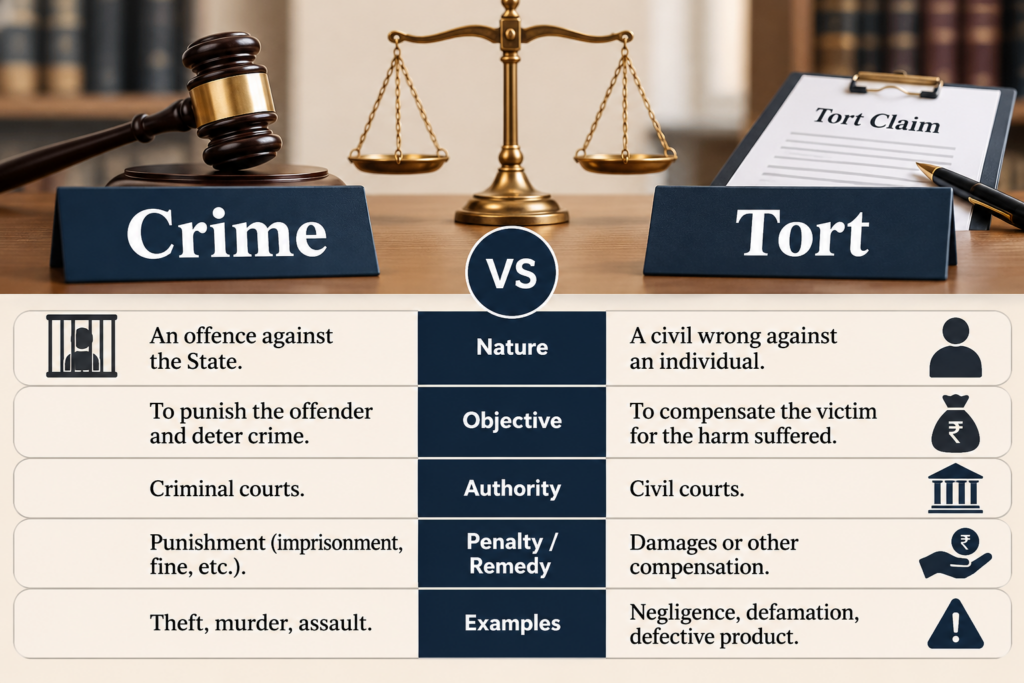
Crime VS Tort: Differences
Basically the difference in crime and tort lies in nature, purpose of the act and to whom the harm is caused.
As a result, their consequences and categories differ.
Crime and tort are both wrongful acts. Their main difference lies in whether they affect an individual or public at large. The consequences of such acts are different depending upon whether its specifics are categorized a tort or a crime and thus fall under the provisions of that law respectively.
Crime vs Tort: Comparison Table
| Basis | Crime | Tort |
| Nature | Criminal wrong | Civil wrong |
| Against whom? | Society or State | Individual or their legal rights |
| Who starts the case? | Generally, the State initiates the prosecution, with an FIR or complaint. | Generally, The injured party (plaintiff) files a civil suit. |
| Main purpose | Punishment, deterrence and protection of society | Compensation or other civil relief |
| Court | Criminal court | Civil court |
| Parties | State vs. Accused | Plaintiff vs. Defendant |
| Standard of proof | Beyond a reasonable doubt | Balance (preponderance) of probabilities |
| Consequences | Imprisonment, fine or other criminal penalties | Damages (compensation), injunction, etc. |
| Governing law in India | BNS, 2023 and other criminal statutes. | Principles of tort law developed mainly through judicial decisions |
| Mens rea | Generally required | Often not required, as in negligence |
| Examples | Murder, Robbery, Human Trafficking, etc. | Nuisance, Negligence, Trespass, etc. |
Conclusion
Above is Tort and Crime discussed in simple terms. What categorizes a wrongful act as a crime or tort, depends on the purpose and whom it affected.
A tort repairs the harm done to one person, a crime punishes the harm done to society, and sometimes one act can lead to both.
Written By
Alisha Qureshi
